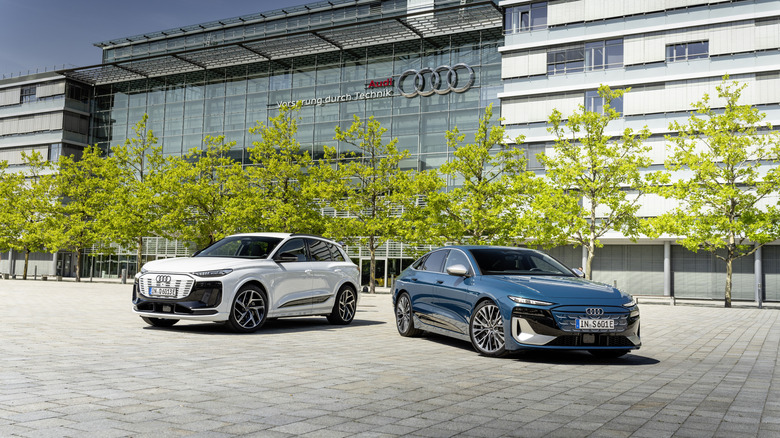
The crisp bite of an early morning drive in an Audi – the precise steering, the surefooted grip, the subtle growl of the engine hinting at unleashed power – is a sensation familiar to enthusiasts worldwide. But have you ever paused, amidst the joy of the drive, to consider the story behind the badge? Whoreallymakes an Audi, and where does that magic happen?
The answer, while seemingly simple, unfolds into a fascinating tale of corporate ownership, global manufacturing, and a relentless pursuit of engineering excellence. Audi, as a brand, is synonymous with sophisticated design and cutting-edge technology. But it exists within a larger framework, a crucial piece of the Volkswagen Group puzzle. Understanding this relationship is key to appreciating the global reach and enduring success of the four rings.
If you’re eyeing that next Audi, whether it’s a sporty S4 or a practical Q5, knowing where it was assembled and the forces that shaped its creation can add a whole new dimension to your ownership experience. Think of it as unlocking a secret level in the Audi game – a deeper appreciation for the engineering and heritage you're investing in.
Who Owns Audi? The Volkswagen Group Connection
The short answer: Audi is owned by the Volkswagen Group (VW Group), one of the world's largest automotive conglomerates. This relationship, however, is far from a simple parent-child dynamic. Audi operates as a distinct brand within the VW Group portfolio, retaining its own engineering teams, design studios, and manufacturing processes. Think of it as a talented sibling within a large family, sharing resources but fiercely independent in its creative output.
The story of Audi's integration into the VW Group is steeped in post-war German history. In the 1960s, Volkswagen acquired Auto Union, the company that would eventually become Audi. At the time, Auto Union was struggling, and Volkswagen's resources and expertise were instrumental in revitalizing the brand. This acquisition proved to be a shrewd move. Under VW's guidance, Audi blossomed, evolving from a manufacturer of relatively simple cars to a global powerhouse known for its technological innovation and premium quality.
The VW Group's ownership allows Audi to benefit from economies of scale, shared platform development (like the MQB platform underpinning many VW and Audi models), and access to advanced technologies like electric vehicle powertrains and autonomous driving systems. Yet, Audi maintains its distinct brand identity, focusing on premium materials, performance engineering, and a sophisticated design language. This balance between shared resources and brand autonomy is crucial to Audi's success.
What Other Brands Does the Volkswagen Group Own?
The Volkswagen Group's portfolio is a veritable who's who of the automotive world. Besides Audi, the group owns brands like Volkswagen (obviously!), Porsche, Lamborghini, Bentley, Bugatti, Škoda, SEAT, and even motorcycle manufacturer Ducati. This diverse range allows the VW Group to cater to a wide spectrum of customers, from budget-conscious consumers to ultra-luxury car enthusiasts.
How Does VW Group Ownership Affect Audi's Design and Engineering?
While Audi maintains its independent design studios and engineering teams, being part of the VW Group allows it to leverage shared platforms and technologies. This translates to cost savings and faster development times. For example, the electric Audi e-tron shares its platform with other VW Group electric vehicles, allowing Audi to bring its electric models to market more quickly and efficiently. However, Audi engineers then tailor and refine these shared technologies to meet Audi's specific performance and handling targets.
Where Are Audis Built? A Global Manufacturing Footprint
Audi's manufacturing footprint is as global as its market reach. While its headquarters and spiritual home remain in Ingolstadt, Germany, Audi vehicles are assembled in numerous factories around the world. This strategic distribution allows Audi to optimize production costs, respond quickly to local market demands, and mitigate potential disruptions in the supply chain.
Here's a look at some of Audi's key manufacturing locations: Ingolstadt, Germany: The heart and soul of Audi. Ingolstadt is home to Audi's headquarters and one of its largest production facilities. This plant produces a wide range of models, including the A3, A4, A5, and Q2. Neckarsulm, Germany: Another key German production site, Neckarsulm is where Audi builds some of its high-performance models, including the A6, A7, A8, and R8. Győr, Hungary:This plant plays a crucial role in Audi's engine production, supplying engines to various VW Group brands. It also assembles the Audi Q3 and Q3 Sportback.
San José Chiapa, Mexico: This facility produces the Audi Q5 for the North American and global markets.
Changchun, China: Audi has a significant presence in China, the world's largest automotive market. Its joint venture with FAW Group produces several Audi models specifically for the Chinese market.
Bratislava, Slovakia: While not exclusively an Audi plant, the Volkswagen Group facility in Bratislava produces the Audi Q7 and Q8 alongside other VW Group SUVs.
The specific model you're interested in will determine its country of origin. Checking the VIN (Vehicle Identification Number) can help you pinpoint the exact assembly plant. The VIN contains information about the manufacturer, the vehicle's characteristics, and its production location.
Why Does Audi Manufacture Cars in Different Countries?
Audi's global manufacturing strategy is driven by several factors: Cost Optimization:Manufacturing in countries with lower labor costs can help Audi reduce its overall production expenses.
Market Proximity: Building cars closer to key markets, like China and North America, reduces transportation costs and allows Audi to respond more quickly to local demand.
Trade Agreements: Manufacturing in certain countries can help Audi take advantage of favorable trade agreements and avoid import tariffs.
Capacity Expansion: As demand for Audi vehicles grows, expanding production capacity in different locations is necessary to meet global demand.
Does the Location of Manufacture Affect the Quality of an Audi?
This is a common concern for potential buyers, but the short answer is generally no. Audi maintains strict quality control standards across all its manufacturing facilities, regardless of location. The same rigorous processes, training, and technology are employed in Ingolstadt, Germany, as they are in San José Chiapa, Mexico. While anecdotal evidence and individual experiences may vary, there's no systemic evidence to suggest that Audis built in certain countries are inherently less reliable or of lower quality than those built in Germany.
Audi Reliability: What To Expect
Audi's reputation for reliability has seen its ups and downs over the years. While older models were sometimes plagued by electrical gremlins, modern Audis have generally improved in terms of reliability, though they still don't always top the charts. A key factor impacting reliability is the complexity of the technology packed into Audis. Features like advanced driver-assistance systems, complex infotainment systems, and sophisticated engine management systems can introduce potential points of failure.
When evaluating Audi reliability, it's essential to consider the specific model and model year. Some models, like the Q5, consistently perform well in reliability surveys, while others may have a less stellar track record. Researching common problems associated with a particular model and year can help you make an informed buying decision.
Regular maintenance is crucial for ensuring the longevity and reliability of any Audi. Adhering to the manufacturer's recommended maintenance schedule, using high-quality parts and fluids, and addressing minor issues promptly can help prevent more significant problems down the road.
Are Audis Expensive to Maintain?
Compared to mainstream brands like Toyota or Honda, Audis generally cost more to maintain. This is due to a combination of factors, including the higher cost of parts, the specialized knowledge required to service them, and the use of premium materials and components. However, regular maintenance and proactive care can help mitigate these costs.
What Are Some Common Audi Reliability Issues?
Some common issues reported by Audi owners include: Oil leaks: Especially in older models. Electrical problems: While less common than in the past, electrical issues can still occur, particularly in models with complex infotainment systems. Turbocharger problems: Common in turbocharged engines if not properly maintained. DSG (Direct-Shift Gearbox) issues: Some owners have reported problems with the DSG transmission, especially in earlier models.
The Future of Audi: Electrification and Beyond
Audi is heavily invested in the future of electric mobility. The e-tron lineup, including the e-tron SUV, e-tron GT, and Q4 e-tron, represents Audi's commitment to electrification. The company plans to launch numerous new electric models in the coming years, and eventually phase out internal combustion engines altogether. This transition to electric power will undoubtedly reshape Audi's manufacturing footprint, with more plants being retooled to produce electric vehicles and batteries.
Beyond electrification, Audi is also exploring advancements in autonomous driving technology, connectivity, and sustainable manufacturing practices. The company aims to be a leader in these areas, ensuring that Audi remains at the forefront of automotive innovation for decades to come.
Knowing where your Audi was built and understanding the forces that shaped its creation adds a new dimension to the driving experience. It connects you to a global network of engineers, designers, and factory workers who pour their expertise and passion into every vehicle. From the historic factories in Germany to the modern facilities in Mexico and China, Audi's manufacturing footprint reflects its global ambitions and unwavering commitment to excellence. As you grip the wheel and experience the thrill of the open road, remember that you're not just driving a car; you're driving a piece of history, a symbol of innovation, and a testament to the power of global collaboration. So go ahead, embrace the four rings and experience the future of driving, today.
Posting Komentar untuk "who makes audi cars and Where They’re Built"